Sigrun Hobbel
Sigrun Hobbel is an Acem Meditation initiator and used to work as a high school teacher. She has a master in Nordic languages and literatures.
Some people wonder what Acem stands for. The name itself means nothing. The organization has developed through practice. From this, at least seven central “pillars” can be highlighted.
There are many different meditation techniques. Most are based on concentration. Acem meditation is one of the few that is based on the principle of free mental attitude, combined with the use of sound: “Sit comfortably with your eyes closed, repeat the method sound easily and effortlessly in your mind, and let thoughts come and go freely.”
This provides a spontaneous relaxation response where more is allowed to happen. Over time, this training in free mental attitude also means the opportunity to let go of what binds and limits you. The combination of “sound and free mental attitude” has been fundamental in Acem ever since the organization was founded by Are Holen in 1966. The process is not static, and so ambiguous that you can immerse yourself in this again and again. The principle of the free mental attitude is central to Acem's activities.
The experience of teaching interested people Acem meditation showed that it is useful to try to put into words what is unclear in the performance. This reinforces the process. Meditation guidance in groups became an important supplement early on and is always a part of the program on courses and retreats.
When training new course teachers, principles around meditation guidance are central. Guidance skills take time to develop. The key is to ask open questions that get the meditator to reflect for themselves. Sometimes it is also about being able to capture the unspoken. The guide does not have the answers, but is a facilitator so that the meditator can understand more of their own performance and process.
Early on, we learned that longer meditations enhance the benefits and understanding of meditation. A long meditation - meditating continuously for more than an hour - is also an important element of basic courses. Course participants are given an early opportunity to experience long meditation, something they enjoy.
All Acem centers offer long meditations of 1 1/2 hours. In addition, there are many options, at drop-in retreats, weekly retreats and immersion. Combined with long meditations, mediation guidance in groups follows, and seminars with a meditative focus.
Meditative yoga is a calm stretching of the body through various exercises combined with free breathing. Supplementing meditation with yoga is effective. You often meditate better.
As early as 1968, the Norwegian Yoga School, Norway's first yoga school, was formally founded by Are Holen. The yoga school arranges its own yoga courses in the evening or yoga retreats. Meditative yoga is a regular part of the program at meditation retreats.
Communication groups are an open and safe group process that provides an opportunity to both get to know yourself better and others. Every year, Acem arranges an eight-day communication course at Halvorsbøle.
Communication groups were started internally in 1970, to develop and strengthen the leadership environment. It proved so impactful that from 1983 it became an open course for all interested parties. You do not have to have learned Acem meditation to participate.
The Acem magazine and the cultural journal Dyade saw were started early. In addition, the expression “Books and Buildings” emerged. Beyond books, Acem needed a home for its activities.
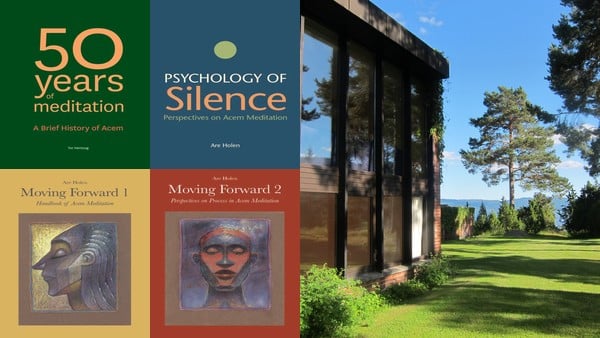
The understanding of the technique and meditation psychology is constantly developing. As early as 1976, the “basic book on Acem meditation”, The Psychology of Silence, was published. It has been printed in several large editions, later also revised and expanded, and translated into Swedish, Danish, Dutch, English, Spanish and Chinese. Today, Acem has published 54 books and CDs. The latest are Moving Forward 1 and Moving Forward 2.
For many years, Acem’s events took place privately or in rented premises; in classrooms, libraries, office spaces, hotels and student residences. How to obtain its own premises? The procedure was a major effort. Several giga-flea markets in Oslo were arranged, each generating several hundred thousand kroner - the last in 1982 with a profit of NOK 750,000. In addition, art portfolios and symbolic, supportive "Sporveisparter" were sold, and loans were taken out from the bank.
In 1976, the first course premises were purchased, a dilapidated parish house at Sporveisgata 37. After two years of renovation, mostly through volunteer work, the premises were inaugurated by the mayor of Oslo. Later, Acem has managed to obtain premises in several places, and not least its own international retreat center, Halvorsbøle, which in 2003 came up for sale as a bankruptcy estate. In addition, there is the beautiful Lundsholm retreat center in Värmland in Sweden.
Acem's course premises and its own events have been a green line from the start; serving vegetarian food, no smoking and no alcohol being served.
The underlying driving force for all of this, for Acem to exist, is volunteerism. Unpaid idealistic work from many hundreds of people in Norway and several other countries - course teachers, moderators, meditation teachers and members. People who find it meaningful to contribute to others getting the most out of Acem meditation, and to realizing Acem's vision.
Sigrun Hobbel is an Acem Meditation initiator and used to work as a high school teacher. She has a master in Nordic languages and literatures.